
Funded through the SSPC EPE Bursary, The Chemistry School of Growth (CSG) an open Instagram page to foster a high school student community around chemistry in Ireland. With a focus on curricula derived content, exam tips, representation in science and wellbeing, the CSG page is a broad reservoir of chemistry related content.
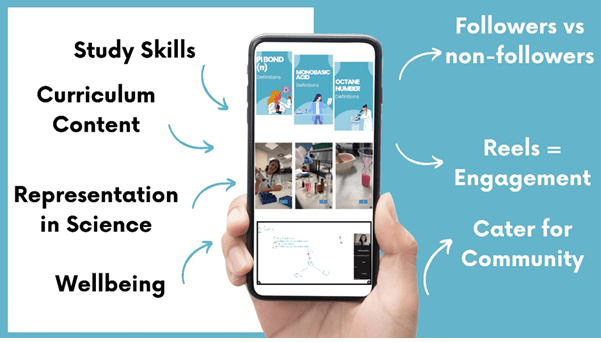
With around 3500 followers, the page promotes chemistry related content to a wide audience. Instagram was selected as the main platform to develop the page given that it is free and has an estimated 800 million monthly users. Moreover, it is especially useful for chemistry education as the platform is grounded in visual imagery. Instagram can also be used to create quizzes, polls and challenges making it more educator friendly over other platforms. The platform provides space for users to follow, like, comment, question and debate rendering it wholly suitable to educational endeavors.
The motivation behind the CSG page is to provide an online space for students and the public to positively engage with chemistry. Secondarily, our focus on student wellbeing is motivated by elevated stress in the final years of schooling.
Finally, chemistry related content is derived from the Irish curriculum as we directly target the needs of the userbase. Typical posts focus on exam questions, definitions and chemistry concepts. While post descriptions may seem divergent, CSG merges these three areas to provide a unique learning space. Types of posts and the processes behind their creation will be detailed in the following section.
Creating Content
Content from the CSG page is diverse in nature and thematically links to chemistry and science. In general, content can be divided into ‘posts’, ‘reels’ and videos. Posts contain a single image or a sequence of images that the user clicks though called a ‘carousel’. Reels are short-form videos that can be up to 90 seconds in length. Reels were made through filming on an iPhone and posts were created from photos taken with an iPhone or through graphic design applications on TikTok and Canva. Videos provide for longer form content are generally used for tutorials on specific chemistry subject areas. The content is derived from research in university chemistry labs and the Irish chemistry curriculum. Figures below illustrate these examples.
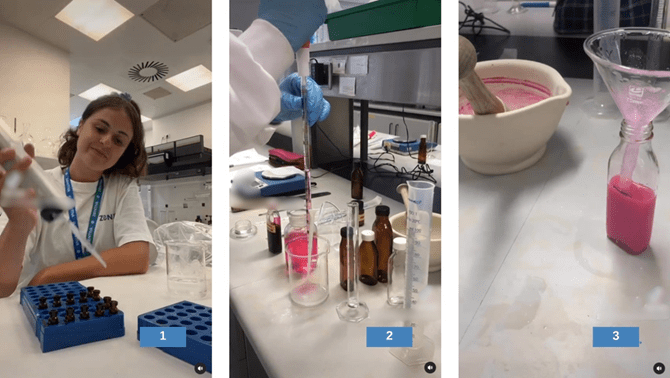
Images from an in-person reel with a video montage of chemistry and pharmacy labs talking about titrations, making liquid formulations and capsules.
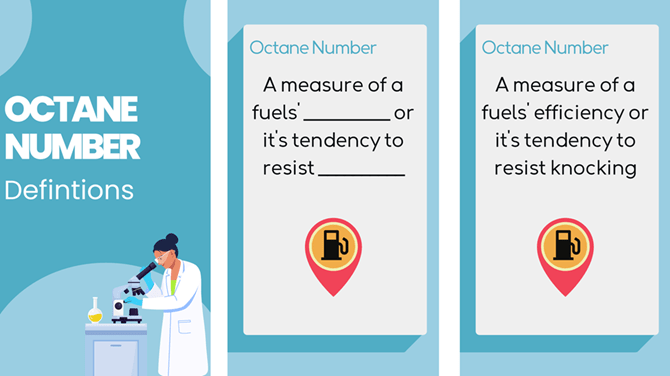
Images from a text-based post with a simple cloze test for a definition in the Irish chemistry curriculum.
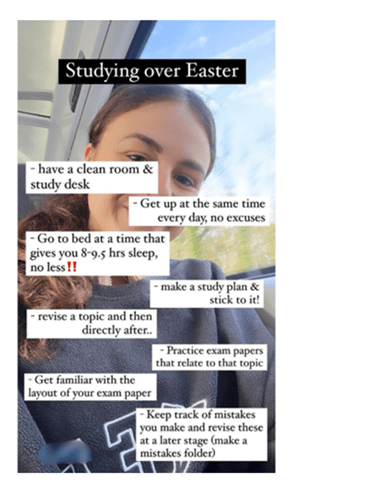
An amalgamation of both in person and text-based content types with a focus on study tips for a holiday break, and right, Images taken from video content on the CSG page. Meeting software was used to meet participants online and teach them live about a subject area. The video is then uploaded to the CSG page for the rest of the community.
Engagement with the CSG page
Given that the CSG community is completely online, engagement with content was measured solely with Instagram metrics. Such metrics include, number/type of followers, number of likes, views, reach and saves.
As noted previously, CSG has around 3500 followers. In terms of gender, 59.5% of followers are female and 40.5% are male. This split is to be expected given that the page primarily features a female researcher. In terms of the age of followers, most followers are aged between 18 – 24 (figure below).
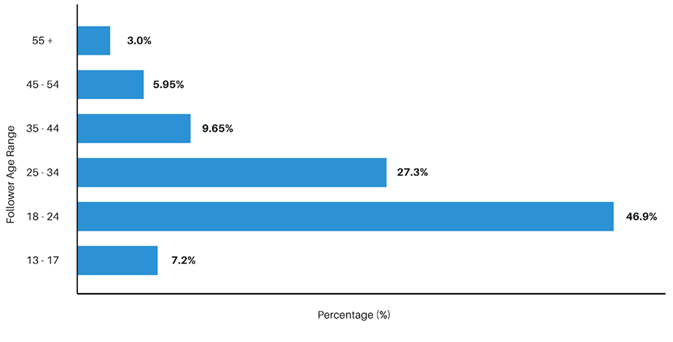
Percentage age range breakdown of CSG page followers.
This result aligns with overall Instagram engagement and makes sense given that the study focused nature of the page is dedicated towards terminal exams in Ireland where students are typically 18 years old.
Moreover, exam and study related reels attained the most views, reached the most accounts and received the most likes which can be defined as a positive sign of interactive engagement. The top 5 reels averaged 2520 views from 1114 accounts (table 1). Exam based content provides a value proposition to the viewer and acts as a ‘hook’ for engagement. However, the type of exam-based content impacts engagement pertaining to page followers and non-followers. We found that generic exam content with titles such as “Study tips to improve your grades” and “How to ace your classes” had a higher level of engagement from non-page followers than followers (table 1). Conversely, reels with more specific titles such as “Chemical bonding tutorial” and “Exam questions part 1/4” engaged the core audience of followers. More generic and less focused materials applied to a larger audience of chemistry learners in the Instagram ecosystem spread further afield. More specific exam and chemistry-based content appealed to the base page followers. While the findings are logical, it is a useful delineation for those who would like to grow and foster an online community.

Overall, reels were the most successful type of content on the page. This aligns with papers that argue the merits of short form video content as an engaging means of science communication.
With regard to posts, the best performing content in terms of views was content linked to events such as exam days and International Women’s Day. Definition posts were not as successful with a lower view rate; however, these posts were the most saved. The save feature allows a user to store a particular post so that it can be retrieved at a later point. Of the views, 81.5% came from followers. This again implies that exam centric content is important for channel followers who are using the content for revision purposes. Finally, while content linked to wellbeing and motivation is dispersed throughout a variety page content, posts that were solely motivational such as quotes (table 2) mainly engaged followers. Of the top five quotes, 86.6% of accounts reached were followers.

This would indicate that these posts appearing in isolation on a feed are not as engaging as when they are in the context of full CSG page. However, given that these posts are the simplest and fastest to create, there is some potential value in engaging a small number of non-followers while also catering for the base community.
Conclusion
The Chemistry School of Growth Instagram page features chemistry related content designed to build an online community through posts linked to curricula, wellbeing and representation of science. Types of post including video reels, text-based images and in-person content provide flexibility in terms of message and enables diverse content. Through Instagram metrics, it was found that a mix of approaches heightened user engagement with curricula driven content providing the foundation for repeat and sustained page visits. Moreover, exam and curricula focused content were favored by followers whereas more generic exam and inspirational content was better at engaging non-followers.
References
(1) McCauley, V.; McHugh, M. An Observational Narrative of Student Reaction to Video Hooks. Education Sciences 2021, 11 (6), 286. DOI: doi:10.3390/educsci11060286.
(2) Prindle, C. R.; Orchanian, N. M.; Venkataraman, L.; Nuckolls, C. Short-Form Videos as an Emerging Social Media Tool for STEM Edutainment. Journal of Chemical Education 2024, 101 (3), 1319-1324. DOI: 10.1021/acs.jchemed.3c01185.
(3) Frohock, B. H.; Macallister, C. A.; Gallardo-Williams, M. T. Engagement of Students in an Organic Chemistry Lecture/Lab Course via Social Media Using Twitter. Journal of Chemical Education 2022, 99 (9), 3304-3309. DOI: 10.1021/acs.jchemed.2c00237.
(4) Dubovi, I.; Tabak, I. Interactions between emotional and cognitive engagement with science on YouTube. Public Underst Sci 2021, 30 (6), 759-776. DOI: 10.1177/0963662521990848 From NLM.
(5) Hayes, C.; Stott, K.; Lamb, K. J.; Hurst, G. A. “Making Every Second Count”: Utilizing TikTok and Systems Thinking to Facilitate Scientific Public Engagement and Contextualization of Chemistry at Home. Journal of Chemical Education 2020, 97 (10), 3858-3866. DOI: 10.1021/acs.jchemed.0c00511.
(6) Hight, M. O.; Nguyen, N. Q.; Su, T. A. Chemical Anthropomorphism: Acting Out General Chemistry Concepts in Social Media Videos Facilitates Student-Centered Learning and Public Engagement. Journal of Chemical Education 2021, 98 (4), 1283-1289. DOI: 10.1021/acs.jchemed.0c01139.
(7) Ye, S.; Hartmann, R. W.; Söderström, M.; Amin, M. A.; Skillinghaug, B.; Schembri, L. S.; Odell, L. R. Turning Information Dissipation into Dissemination: Instagram as a Communication Enhancing Tool during the COVID-19 Pandemic and Beyond. Journal of Chemical Education 2020, 97 (9), 3217-3222. DOI: 10.1021/acs.jchemed.0c00724.
(8) Smith, D. K. iTube, YouTube, WeTube: Social Media Videos in Chemistry Education and Outreach. Journal of Chemical Education 2014, 91 (10), 1594-1599. DOI: 10.1021/ed400715s.
(9) Pavelle, S.; Wilkinson, C. Into the Digital Wild: Utilizing Twitter, Instagram, YouTube, and Facebook for Effective Science and Environmental Communication. Frontiers in Communication 2020, Volume 5 – 2020, Original Research. DOI: 10.3389/fcomm.2020.575122.
(10) Korich, A. L. Harnessing a Mobile Social Media App To Reinforce Course Content. Journal of Chemical Education 2016, 93 (6), 1134-1136. DOI: 10.1021/acs.jchemed.5b00915.
(11) Romney, M.; and Johnson, R. G. Show me a story: narrative, image, and audience engagement on sports network Instagram accounts. Information, Communication & Society 2020, 23 (1), 94-109. DOI: 10.1080/1369118X.2018.1486868.
(12) McGuire, L.; Mulvey, K. L.; Goff, E.; Irvin, M. J.; Winterbottom, M.; Fields, G. E.; Hartstone-Rose, A.; Rutland, A. STEM gender stereotypes from early childhood through adolescence at informal science centers. Journal of Applied Developmental Psychology 2020, 67, 101109. DOI: https://doi.org/10.1016/j.appdev.2020.101109.
(13) Begeny, C. T.; Ryan, M. K.; Moss-Racusin, C. A.; Ravetz, G. In some professions, women have become well represented, yet gender bias persists-Perpetuated by those who think it is not happening. Sci Adv 2020, 6 (26), eaba7814. DOI: 10.1126/sciadv.aba7814 From NLM.
(14) Wuthrich, V. M.; Jagiello, T.; Azzi, V. Academic Stress in the Final Years of School: A Systematic Literature Review. Child Psychiatry Hum Dev 2020, 51 (6), 986-1015. DOI: 10.1007/s10578-020-00981-y From NLM.
(15) Banks, J.; and Smyth, E. ‘Your whole life depends on it’: academic stress and high-stakes testing in Ireland. Journal of Youth Studies 2015, 18 (5), 598-616. DOI: 10.1080/13676261.2014.992317.
(16) Su, L. Y.-F.; McKasy, M.; Cacciatore, M. A.; Yeo, S. K.; DeGrauw, A. R.; Zhang, J. S. Generating Science Buzz: An Examination of Multidimensional Engagement With Humorous Scientific Messages on Twitter and Instagram. Science Communication 2022, 44 (1), 30-59. DOI: 10.1177/10755470211063902.